EdTech Investment Boom: 5 Key Trends Shaping U.S. Learning Platforms by 2026

The EdTech Investment Boom is transforming U.S. learning platforms, driven by rapid innovation and evolving educational needs. This analysis highlights 5 pivotal trends shaping the sector through 2026, offering crucial insights for stakeholders. Understanding these shifts is essential for navigating the dynamic landscape of educational technology investments.
The EdTech Investment Boom: 5 Key Trends Shaping U.S. Learning Platforms by 2026 is currently dominating discussions among educators, investors, and technologists across the United States. Recent reports indicate a significant surge in capital flowing into educational technology, signaling a robust and transformative period for the industry.
This unprecedented investment wave is not merely a transient phenomenon but a sustained trajectory, poised to reshape how learning is delivered and consumed. Stakeholders are keenly observing how these financial injections will manifest in tangible innovations and widespread adoption across various educational segments.
As we approach 2026, the confluence of technological advancement, shifting pedagogical approaches, and increased demand for flexible learning solutions positions the U.S. EdTech market for substantial evolution. This report delves into the critical trends steering this dynamic growth, providing a clear perspective on what to expect.
Surge in Venture Capital and Private Equity Funding
The U.S. EdTech sector has witnessed an extraordinary influx of venture capital (VC) and private equity (PE) funding over the past few years. This capital injection is fueling rapid innovation and expansion, enabling startups and established companies alike to develop cutting-edge solutions.
Analysts report that 2023 and 2024 saw record-breaking investment figures, with a significant portion directed towards platforms addressing K-12, higher education, and corporate training needs. This robust financial backing underscores investor confidence in the long-term viability and growth potential of educational technology.
The continued momentum into 2025 and 2026 suggests that the EdTech Investment Boom is far from over, with new rounds of funding regularly announced for promising ventures. This sustained investment is critical for maintaining the pace of development and ensuring platforms can meet evolving user demands.
Key Drivers of Funding Growth
Several factors are converging to drive this unprecedented funding growth within the EdTech landscape. The accelerated digital transformation of education, intensified by recent global events, has created a fertile ground for technological adoption and innovation.
Furthermore, the increasing recognition of lifelong learning and upskilling needs in a rapidly changing job market is compelling both individuals and corporations to seek effective digital learning solutions. Investors are capitalizing on these macro trends, seeing EdTech as a resilient and high-growth sector.
- Increased demand for online learning solutions across all age groups.
- Technological advancements making platforms more engaging and effective.
- Government initiatives and policy support for digital education integration.
- Growing awareness of the importance of continuous skill development.
Impact on Market Consolidation
The substantial funding is also leading to a heightened period of mergers and acquisitions (M&A) within the EdTech space. Larger, well-capitalized companies are acquiring smaller, innovative startups to expand their market share, integrate new technologies, and diversify their product offerings.
This consolidation trend is expected to continue through 2026, resulting in a more streamlined yet competitive market dominated by a few major players alongside niche innovators. The strategic acquisitions are often aimed at creating comprehensive ecosystems that cater to a wider array of educational needs.
For investors, this signals both opportunities for lucrative exits and the potential for creating dominant platforms that can sustain long-term growth. The EdTech Investment Boom is thus not only about new entrants but also about the strategic restructuring of the existing market.
Hyper-Personalization Powered by AI and Adaptive Learning
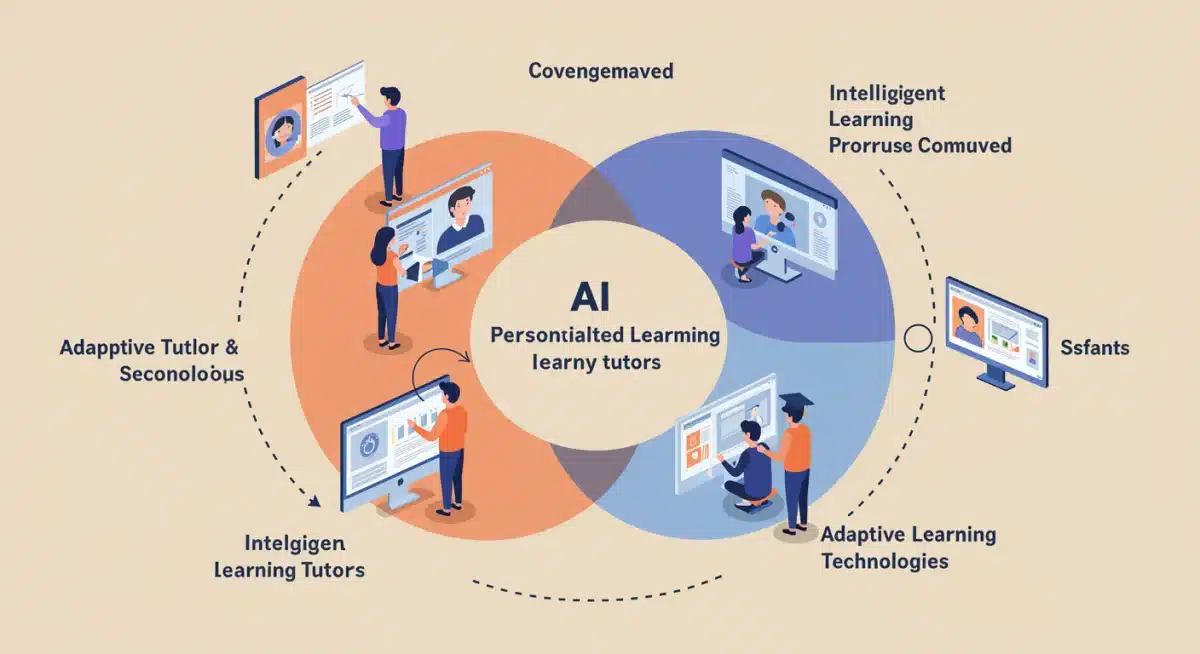
One of the most transformative trends fueled by the EdTech Investment Boom is the rapid advancement in hyper-personalization, primarily driven by artificial intelligence (AI) and adaptive learning technologies. These innovations are moving beyond generic learning paths to truly individualized educational experiences.
AI algorithms are now sophisticated enough to analyze student performance, identify learning gaps, and recommend tailored content and teaching methods in real-time. This level of customization ensures that each learner receives instruction that is optimally suited to their pace, style, and proficiency.
By 2026, the integration of AI will be a standard feature in leading U.S. learning platforms, creating dynamic and responsive educational environments. This shift promises to significantly enhance engagement, improve learning outcomes, and address diverse student needs more effectively.
AI-Driven Content Curation and Delivery
AI’s role in content curation is becoming increasingly vital, allowing platforms to dynamically select and present learning materials that are most relevant and challenging for individual students. This goes beyond simple recommendations, involving complex analyses of hundreds of data points per user.
Moreover, AI is enabling the development of intelligent tutoring systems that can provide instant feedback, answer questions, and even simulate conversations to deepen understanding. These systems are designed to augment, not replace, human instructors, freeing up educators to focus on higher-level mentoring and support.
- Real-time assessment and feedback mechanisms.
- Dynamic adjustment of curriculum difficulty and pace.
- Personalized learning pathways based on individual progress.
- AI-powered virtual assistants for student support and guidance.
Adaptive Assessment and Skill Gap Identification
Adaptive learning platforms are revolutionizing assessment by moving away from static tests towards continuous, dynamic evaluation. These systems adjust the difficulty of questions based on a student’s responses, providing a more accurate measure of their knowledge and skill proficiency.
This continuous assessment allows for precise identification of specific skill gaps, enabling platforms to immediately direct students to remedial content or offer targeted practice. The goal is to ensure mastery of foundational concepts before moving on to more advanced topics, preventing knowledge deficits from accumulating.
The data generated from these adaptive assessments also provides valuable insights for educators and institutions, allowing them to refine teaching strategies and curriculum design. The EdTech Investment Boom is making these sophisticated tools widely accessible.
Growth of Skills-Based Learning and Micro-Credentials
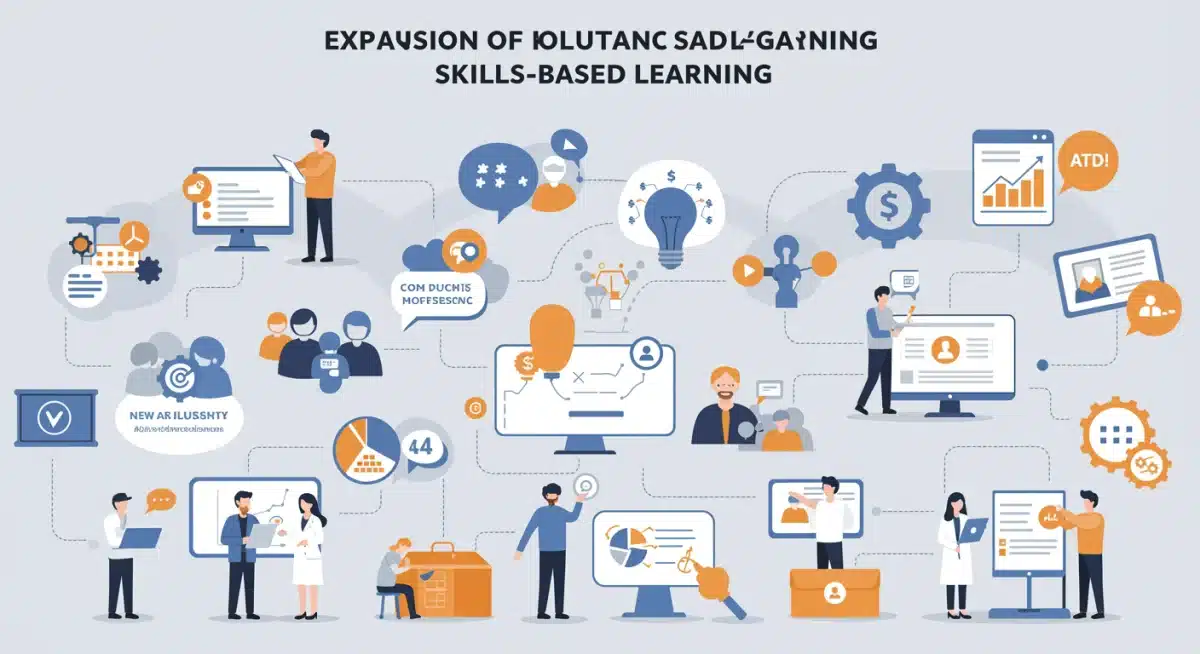
The U.S. education landscape is experiencing a significant pivot towards skills-based learning, a trend strongly supported by the ongoing EdTech Investment Boom. This shift emphasizes the acquisition of practical, job-relevant competencies over traditional academic degrees, responding directly to evolving workforce demands.
Micro-credentials, digital badges, and short-form certification programs are gaining immense traction as flexible and efficient ways to upskill and reskill. These offerings allow individuals to acquire specific, verifiable skills quickly, making them highly attractive to both employees and employers.
By 2026, these alternative credentialing pathways are expected to become a mainstream component of the U.S. learning ecosystem, challenging the dominance of traditional degree programs. The focus is on measurable outcomes and direct applicability in the professional sphere.
Responding to Workforce Demands
The rapid pace of technological change and automation has created a pressing need for a workforce that can continuously adapt and acquire new skills. Traditional education systems often struggle to keep pace with these dynamic requirements, leaving a gap that skills-based EdTech platforms are expertly filling.
Companies are increasingly prioritizing candidates with demonstrated skills and project experience, often valuing these over formal degrees alone. This paradigm shift is pushing both individuals and institutions to embrace more agile and targeted learning solutions.
- Demand for technical skills like AI, data science, and cybersecurity.
- Emphasis on soft skills such as critical thinking, collaboration, and adaptability.
- Industry-recognized certifications gaining currency over traditional degrees.
- Flexibility and speed of learning modules appealing to working professionals.
The Rise of Corporate EdTech
Corporate investment in EdTech platforms for employee training and development is soaring. Companies are recognizing that investing in their workforce’s continuous learning is crucial for maintaining competitiveness and fostering innovation. This has spurred a specialized segment within the EdTech Investment Boom.
These platforms often focus on highly specific professional development, compliance training, and leadership programs, delivered through engaging and interactive digital formats. The ability to track progress and measure ROI makes these solutions particularly attractive to corporate clients.
The collaboration between EdTech providers and corporations is creating a robust market for tailored learning experiences that directly impact business objectives. This symbiotic relationship is a key driver of the overall EdTech market expansion.
Immersive Learning Experiences: VR/AR and Gamification
The integration of virtual reality (VR), augmented reality (AR), and advanced gamification techniques is poised to revolutionize learning experiences, marking a significant frontier in the EdTech Investment Boom. These technologies promise to make education more engaging, interactive, and memorable.
VR and AR applications allow learners to explore complex concepts in 3D environments, conduct virtual experiments, or practice real-world scenarios without risk. This immersive approach can significantly enhance understanding and retention, particularly in fields requiring hands-on experience.
By 2026, we anticipate a broader adoption of these immersive tools in U.S. learning platforms, moving beyond niche applications to become integral components of mainstream education. The potential for creating highly realistic and interactive learning scenarios is immense.
VR/AR for Experiential Learning
Experiential learning, traditionally difficult to scale, becomes highly accessible with VR and AR. Medical students can perform virtual surgeries, engineering students can design and test structures in simulated environments, and history students can walk through ancient civilizations.
These virtual experiences provide a level of engagement and practical application that passive learning methods cannot match. The development of more affordable and accessible VR/AR hardware is also a critical factor driving their increased deployment in educational settings.
- Simulated labs and workshops for scientific and technical fields.
- Virtual field trips and cultural immersion experiences.
- Interactive simulations for soft skills training, like public speaking.
- Enhanced visualization of abstract concepts in STEM subjects.
Gamification for Engagement and Motivation
Gamification techniques, which apply game-design elements and game principles in non-game contexts, are proving highly effective in boosting learner engagement and motivation. Points, badges, leaderboards, and interactive challenges transform learning into a more enjoyable and competitive activity.
These elements tap into intrinsic human desires for achievement and recognition, encouraging sustained effort and deeper interaction with course material. The strategic implementation of gamification can significantly reduce dropout rates and improve overall learning persistence.
Platforms are increasingly sophisticated in their use of gamification, integrating it seamlessly into instructional design rather than as a mere add-on. This trend is a testament to the innovative spirit driving the EdTech Investment Boom.
Expansion of Blended Learning Models and Hybrid Classrooms
The EdTech Investment Boom is catalyzing a permanent shift towards blended learning models and the proliferation of hybrid classrooms across the U.S. educational system. This trend represents a strategic integration of online and in-person instruction, designed to leverage the strengths of both approaches.
Blended learning offers flexibility and personalized pacing through digital resources, while retaining the benefits of direct interaction and collaborative activities in physical settings. This model allows institutions to cater to diverse student populations and learning preferences more effectively.
By 2026, hybrid learning environments are expected to be the norm rather than the exception, from K-12 schools to universities and corporate training centers. This evolution is driven by the proven efficacy of combining digital tools with traditional pedagogical methods.
Reimagining the Physical Classroom
The hybrid classroom redefines the physical learning space, transforming it into a hub for collaborative projects, deeper discussions, and hands-on activities. Technology is used to facilitate synchronous and asynchronous learning, ensuring continuity between in-person and remote participation.
This model necessitates investment in robust digital infrastructure, advanced conferencing tools, and interactive displays that support seamless transitions between different learning modalities. The aim is to create an inclusive environment where all students, regardless of their location, can actively participate and engage.
- Flexible scheduling and attendance options for students.
- Enhanced communication tools for instructors and learners.
- Access to a wider range of digital resources and multimedia content.
- Opportunities for project-based learning and peer collaboration.
Scalability and Accessibility Benefits
Blended learning models offer significant advantages in terms of scalability and accessibility. Institutions can reach a larger and more geographically dispersed student body, breaking down traditional barriers to education. This is particularly crucial for adult learners and those in remote areas.
Furthermore, the digital components of blended learning provide invaluable resources for students with diverse needs, including those requiring accommodations or additional support. The ability to revisit lectures, access supplementary materials, and engage with content at one’s own pace fosters a more equitable learning environment.
The sustained investment in platforms supporting these models reflects a commitment to making quality education more widely available. The EdTech Investment Boom is thus directly contributing to greater educational equity.
Focus on Data Privacy and Ethical AI in Education
As the EdTech Investment Boom propels new technologies into the U.S. learning landscape, a critical focus is emerging around data privacy and the ethical deployment of AI. With vast amounts of student data being collected, safeguarding this information and ensuring responsible AI use are paramount concerns.
Developers and institutions are increasingly prioritizing robust security measures and transparent data governance policies to build trust among users. Regulatory bodies are also stepping up efforts to establish clear guidelines for data handling in educational technology.
By 2026, platforms that demonstrate a strong commitment to privacy and ethical AI will gain a significant competitive advantage, as these factors become non-negotiable for parents, students, and educational organizations. Trust and transparency are becoming key differentiators in the market.
Strengthening Data Security Protocols
The sheer volume and sensitivity of educational data necessitate state-of-the-art security protocols. EdTech companies are investing heavily in encryption, anonymization techniques, and secure cloud infrastructure to protect student information from breaches and unauthorized access.
Compliance with regulations such as FERPA (Family Educational Rights and Privacy Act) and emerging data protection laws is a top priority. Institutions are also conducting more rigorous due diligence when selecting EdTech vendors, demanding verifiable proof of data security efficacy.
- End-to-end encryption for all sensitive student data.
- Strict access controls and multi-factor authentication.
- Regular security audits and vulnerability assessments.
- Transparent policies on data collection, storage, and usage.
Ethical Considerations in AI Development
The ethical implications of AI in education are under intense scrutiny. Concerns include algorithmic bias, the potential for reduced human interaction, and the impact on student autonomy. Developers are working to ensure AI tools are fair, transparent, and enhance rather than diminish the learning experience.
This involves designing AI systems that are explainable, allowing users to understand how decisions or recommendations are made. Furthermore, there’s a growing emphasis on human oversight and intervention points within AI-driven learning processes to prevent unintended negative consequences.
The responsible development and deployment of AI will be a defining characteristic of successful EdTech platforms through 2026. The EdTech Investment Boom is increasingly tied to funding initiatives that prioritize these ethical frameworks.
| Key Trend | Brief Description |
|---|---|
| Funding Surge | Record VC/PE investments fueling innovation and market consolidation. |
| Hyper-Personalization | AI and adaptive learning creating individualized educational experiences. |
| Skills-Based Learning | Growth of micro-credentials and short-form certifications for workforce needs. |
| Immersive Learning | VR/AR and gamification enhancing engagement and experiential learning. |
Frequently Asked Questions About EdTech Investment
The current EdTech Investment Boom is primarily driven by the accelerated digital transformation of education, intensified demand for online learning, and the growing need for continuous upskilling and reskilling in a dynamic job market. Investors recognize the sector’s resilience and long-term growth potential.
AI is profoundly impacting U.S. learning platforms by enabling hyper-personalization, adaptive learning pathways, and intelligent tutoring systems. These AI-driven tools analyze student performance, identify learning gaps, and deliver tailored content, significantly enhancing engagement and learning outcomes for individuals.
Micro-credentials are short, verifiable certifications that attest to a specific skill or competency. They are important because they offer flexible, efficient pathways for individuals to acquire job-relevant skills, addressing the evolving demands of the workforce more rapidly and directly than traditional degrees.
Yes, VR and AR are projected to become more mainstream in U.S. education by 2026. Driven by the EdTech Investment Boom, these technologies offer immersive and experiential learning opportunities that enhance understanding, engagement, and retention, moving beyond niche applications to broader integration.
Data privacy is crucial for EdTech platforms due to the sensitive nature of student information. Robust security measures and ethical data governance build trust among users, comply with regulations like FERPA, and are essential for platforms to gain widespread adoption and maintain credibility in the market.
Looking Ahead
The detailed trends underscore that the EdTech Investment Boom is not merely a financial phenomenon but a fundamental reorientation of the U.S. educational landscape. The convergence of substantial capital, advanced technologies, and evolving learning paradigms promises a future where education is more accessible, personalized, and effective for all.
Stakeholders must continue to monitor developments in AI ethics, data security, and the integration of immersive technologies, as these will define the next generation of learning platforms. The pace of innovation is unlikely to slow, making strategic foresight critical for success in this dynamic sector.
The next few years will undoubtedly solidify the enduring impact of this investment wave, transforming how knowledge is acquired and skills are developed across the nation. The ongoing commitment to innovation and ethical deployment will ensure that the benefits of the EdTech Investment Boom are realized to their fullest potential.
