XR in Education: 3 Cutting-Edge Applications Transforming US Learning
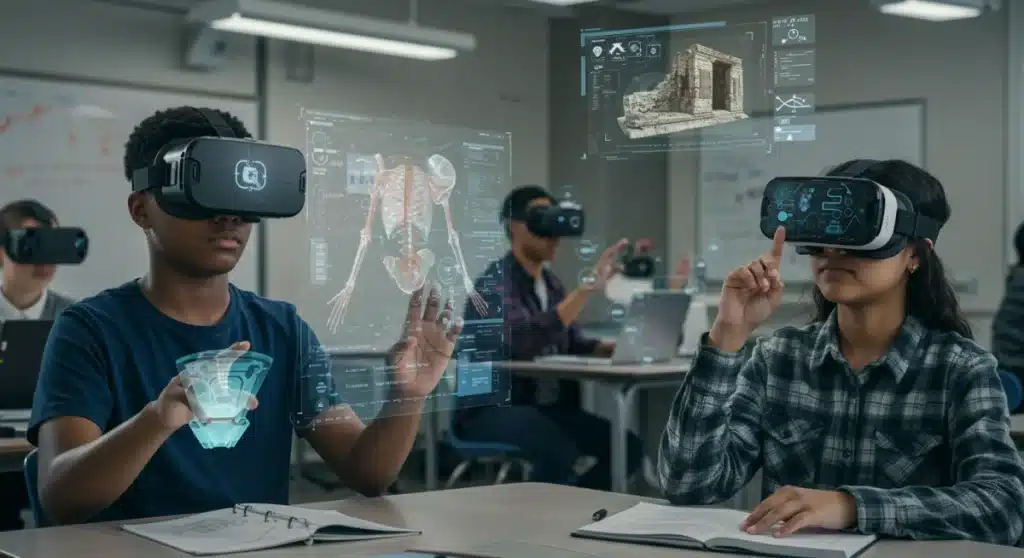
Latest developments on The Rise of XR in Education: 3 Cutting-Edge Applications Transforming U.S. Learning Experiences in 2026, with key facts, verified sources and what readers need to monitor next in the United States, presented clearly in English (United States).
The Rise of XR in Education: 3 Cutting-Edge Applications Transforming U.S. Learning Experiences in 2026 is rapidly becoming a cornerstone of pedagogical innovation across the nation. This technological shift, encompassing virtual reality (VR), augmented reality (AR), and mixed reality (MR), promises to redefine how students engage with academic content.
As the U.S. education system looks towards 2026, the integration of extended reality (XR) is not merely speculative but a tangible reality for many institutions. Early adopters are already demonstrating the profound impact these immersive tools have on comprehension, retention, and overall student engagement.
This report delves into the current landscape, highlighting three pivotal applications that are at the forefront of this educational revolution. We examine their implementation, benefits, and the challenges that still need addressing for broader adoption of XR in Education 2026.
The Immersive Classroom: Virtual Reality for Experiential Learning
Virtual Reality (VR) is fundamentally altering the traditional classroom experience by transporting students to otherwise inaccessible environments. This technology allows for unparalleled experiential learning, making abstract concepts tangible and engaging.
From exploring ancient Roman cities to navigating the human circulatory system, VR offers a dynamic platform for discovery. Educators report increased student curiosity and deeper understanding when subjects are presented in these immersive formats, pushing the boundaries of XR in Education 2026.
The ability to interact with virtual objects and scenarios provides a level of engagement that passive learning methods cannot match. This shift is particularly impactful in subjects that benefit from visual and spatial understanding.
Virtual Field Trips and Historical Recreations
Virtual field trips are emerging as a powerful application, enabling students to visit global landmarks, historical sites, or even distant planets without leaving the classroom. This democratizes access to educational experiences, overcoming geographical and financial barriers.
Historical recreations in VR bring the past to life, allowing students to witness pivotal moments or interact with historical figures in a simulated environment. This vivid re-enactment fosters a deeper connection to history than traditional textbooks ever could, enhancing the reach of XR in Education 2026.
- Students can explore the pyramids of Giza or the Great Wall of China.
- They can participate in virtual reenactments of key historical events.
- Access to diverse cultural experiences is significantly broadened.
Science and Medical Simulations
In science education, VR provides safe and repeatable environments for complex experiments and dissections. Students can manipulate virtual molecules, conduct hazardous chemical reactions, or perform intricate biological procedures without risk or material waste.
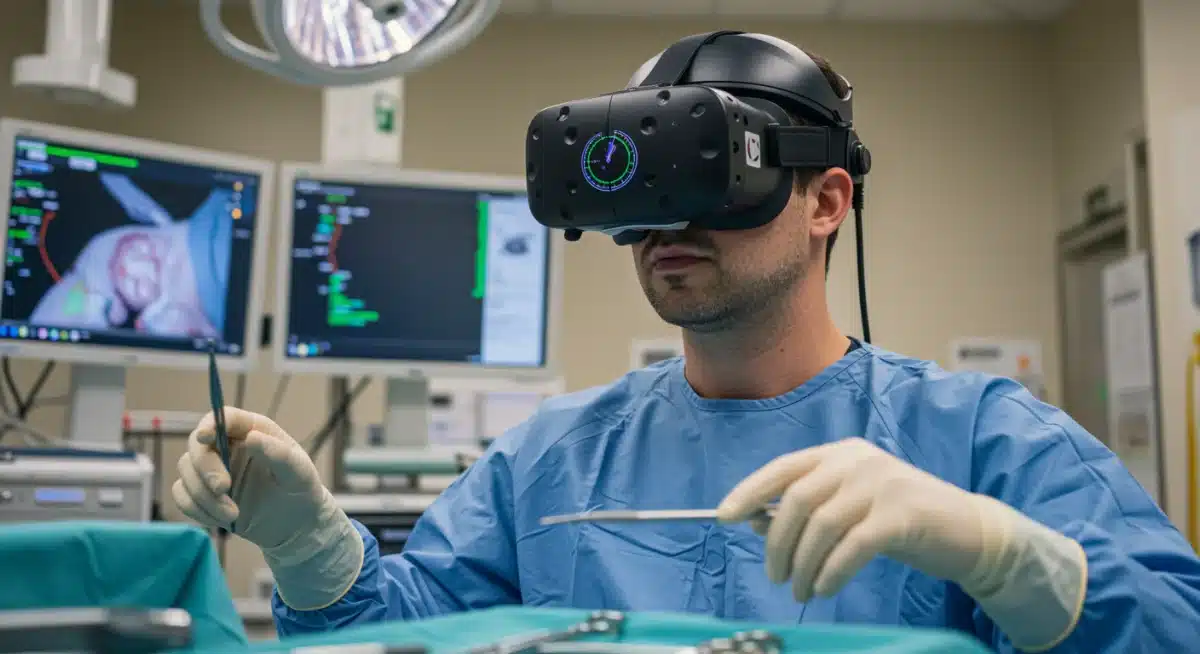
Medical schools are leveraging VR for detailed anatomical studies and surgical training, offering realistic simulations that build practical skills and confidence. This prepares future healthcare professionals with hands-on experience before engaging with real patients, a critical aspect of XR in Education 2026.
- Virtual labs allow for experimentation with expensive or dangerous materials.
- Medical students practice surgical techniques in a risk-free environment.
- Complex biological systems can be explored in three dimensions.
Augmented Reality: Enhancing Real-World Learning
Augmented Reality (AR) integrates digital information with the real world, enriching existing learning environments without fully immersing users. This technology overlays virtual content onto physical objects, offering interactive layers of information.
AR applications are transforming classrooms by making textbooks interactive, bringing static diagrams to life, and providing real-time data overlays during practical tasks. This seamless blend of digital and physical enhances comprehension and engagement, a key element of XR in Education 2026.
The accessibility of AR through common devices like smartphones and tablets makes it a highly scalable solution for educational institutions. Its ability to contextualize information directly within the student’s physical surroundings is a significant advantage.
Interactive Textbooks and Worksheets
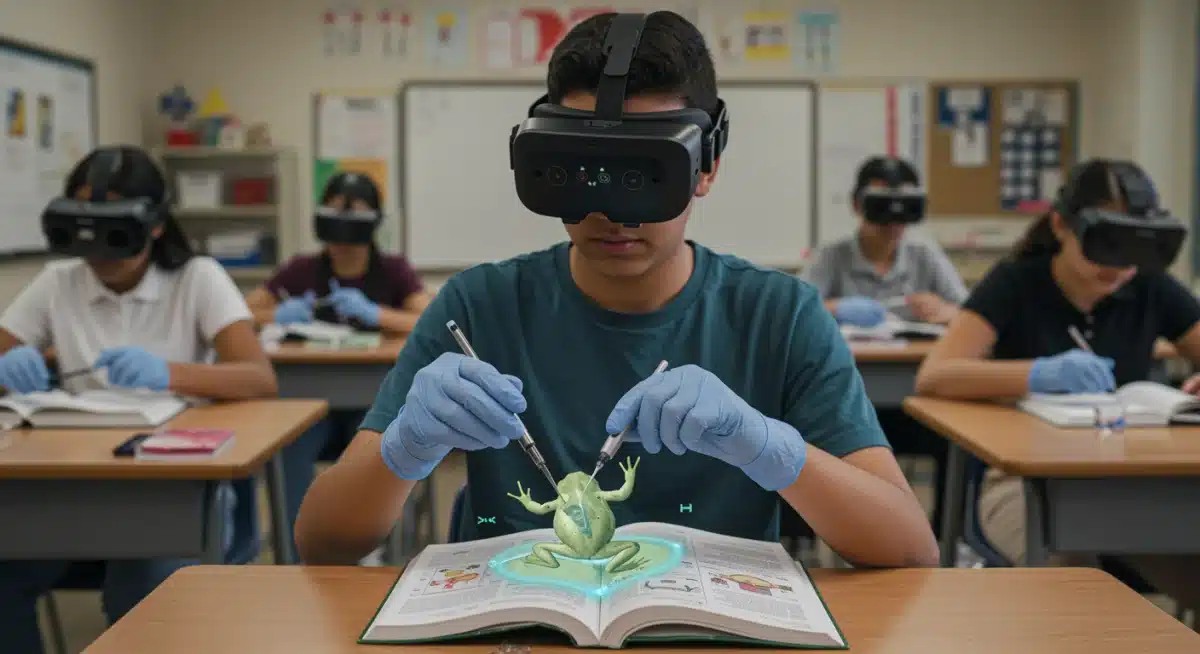
AR-enhanced textbooks allow students to scan pages with a device and see 3D models, animations, or supplementary videos appear directly on the page. This transforms passive reading into an interactive exploration, making learning more dynamic and memorable.
Worksheets and educational games can be augmented with AR, providing instant feedback, guided instructions, or interactive challenges that adapt to the student’s progress. This personalized approach supports diverse learning styles, furthering the impact of XR in Education 2026.
- Students can view 3D models of complex structures from textbooks.
- AR apps can provide interactive quizzes and problem-solving scenarios.
- Learning becomes more personalized and adaptive to individual needs.
Practical Training and Skill Development
In vocational training, AR guides students through complex assembly processes or repair tasks by projecting step-by-step instructions directly onto the equipment. This reduces errors, speeds up learning, and provides a safe environment for practicing dangerous procedures.
For subjects like engineering or architecture, AR allows students to visualize designs in a real-world context, overlaying virtual blueprints onto physical spaces. This helps in understanding scale, spatial relationships, and potential design flaws early on, critical for the evolution of XR in Education 2026.
- Technicians can receive real-time visual guidance for equipment repair.
- Architectural students can walk through virtual building designs on site.
- Manufacturing training benefits from interactive assembly instructions.
Mixed Reality: Blending Realities for Advanced Collaboration
Mixed Reality (MR) represents the most advanced form of XR, seamlessly blending physical and digital worlds to create new environments where physical and virtual objects coexist and interact in real-time. This offers a potent platform for collaborative learning.
MR facilitates shared immersive experiences, allowing students and educators to interact with holographic content as if it were physically present. This opens up unprecedented opportunities for group projects, remote collaboration, and complex problem-solving within the context of XR in Education 2026.
Unlike VR, which isolates users, or AR, which overlays information, MR enables a true hybrid reality. Users can maintain awareness of their physical surroundings while engaging deeply with digital content, fostering natural interaction.
Collaborative Design and Engineering
MR is revolutionizing fields like design and engineering education by enabling students to collaboratively work on 3D models and prototypes. Multiple users can view, manipulate, and annotate the same holographic design from different physical locations, fostering real-time teamwork.
Students can iterate on designs, identify potential issues, and test concepts in a shared virtual space that feels real. This accelerates the design process and significantly improves communication among team members, a vital aspect of XR in Education 2026.
- Teams can co-create and modify 3D designs simultaneously.
- Remote collaboration on complex projects becomes highly effective.
- Instant feedback on design changes is possible within the shared environment.
Advanced Scientific Visualization and Research
In advanced science and research, MR allows scientists and students to visualize complex datasets, molecular structures, or astronomical phenomena as interactive holograms. This provides a new dimension for analysis and discovery, moving beyond traditional 2D representations.
Researchers can collaborate on understanding intricate biological processes or astrophysical models by physically walking around and interacting with their holographic representations. This enhances data interpretation and fuels innovation in scientific inquiry, propelling XR in Education 2026.
- Scientists can explore molecular structures in a shared holographic space.
- Students can visualize complex data in 3D for deeper understanding.
- Collaborative research on theoretical models is greatly enhanced.
Challenges and Opportunities for Widespread Adoption
While the potential of XR in education is immense, several challenges must be addressed for widespread adoption across U.S. learning institutions. These include the cost of hardware, the development of quality educational content, and teacher training.
Hardware expenses for VR and MR headsets, along with powerful computing systems, can be prohibitive for many schools. Ensuring equitable access to these technologies is crucial to prevent exacerbating existing digital divides, a significant consideration for XR in Education 2026.
Furthermore, developing engaging, pedagogically sound XR content requires specialized skills and significant investment. Without a robust ecosystem of educational applications, the hardware alone cannot deliver on its promise.
Addressing Hardware Costs and Accessibility
The cost barrier remains a primary concern for schools and districts. As XR technology matures, prices are expected to decrease, but initial investment can be substantial. Grant programs and public-private partnerships are vital to subsidize these costs.
Ensuring equitable access means not only providing devices but also reliable internet infrastructure and technical support in underserved communities. This holistic approach is essential for truly democratizing the benefits of XR in Education 2026.
- Government grants and educational funding can offset initial hardware costs.
- Bulk purchasing initiatives can reduce unit prices for institutions.
- Public-private collaborations are key to funding infrastructure development.
Content Development and Curriculum Integration
The availability of high-quality, curriculum-aligned XR content is paramount. Educators need tools that directly support learning objectives and integrate seamlessly into existing lesson plans. This requires collaboration between content creators and educational experts.
Developing effective XR experiences demands instructional design expertise combined with technical proficiency in 3D modeling and immersive storytelling. Investment in this area will dictate the true impact of XR in Education 2026.
- Collaboration between educators and XR developers is crucial for relevant content.
- Open-source platforms can foster community-driven content creation.
- Curriculum developers must adapt to incorporate immersive learning modules.
Teacher Training and Pedagogical Shifts
The successful integration of XR technologies hinges on adequately trained educators who understand how to leverage these tools effectively. Teachers need professional development that covers both the technical aspects of XR and innovative pedagogical approaches.
This necessitates a shift in teaching methodologies, moving from traditional instruction to facilitating immersive, student-led discovery. Empowering teachers with these skills is fundamental for maximizing the potential of XR in Education 2026.
Ongoing support and a community of practice will help educators share best practices and overcome implementation challenges. This continuous learning environment is key to sustainable XR integration.
Professional Development Programs
Comprehensive professional development programs are essential to equip educators with the skills needed to implement XR effectively. These programs should focus on practical application, content curation, and troubleshooting common technical issues.
Training should also emphasize how to design lessons that capitalize on XR’s unique capabilities, encouraging critical thinking and problem-solving in immersive environments. This proactive approach ensures teachers are prepared for the demands of XR in Education 2026.
- Workshops on operating XR hardware and software are foundational.
- Training in creating or adapting XR content for specific subjects is vital.
- Emphasis on designing immersive learning activities that promote engagement.
Rethinking Assessment in Immersive Environments
As learning shifts to immersive environments, assessment methods must also evolve. Traditional tests may not fully capture the skills and knowledge gained through XR experiences, necessitating new approaches to evaluation.
Performance-based assessments within VR or MR simulations, where students demonstrate mastery of tasks in a realistic context, can provide a more accurate measure of learning outcomes. This innovative approach is crucial for validating the efficacy of XR in Education 2026.
- Scenario-based assessments within VR can evaluate practical skills.
- Observation of student interaction with virtual objects can provide insights.
- Digital portfolios can showcase projects completed in XR environments.
Policy and Funding for Future Growth
Government policies and dedicated funding initiatives will play a critical role in accelerating the adoption of XR in U.S. education. Strategic investments can support research, content development, and infrastructure improvements.
Policymakers must recognize the transformative potential of XR and allocate resources accordingly, ensuring that schools have the necessary support to integrate these technologies. This proactive stance is vital for the sustained growth of XR in Education 2026.
Establishing clear guidelines and standards for XR implementation can also help schools navigate the complexities of adopting new technologies. This provides a framework for consistent and effective integration across diverse educational settings.
Government Initiatives and Grants
Federal and state governments can launch grant programs specifically designed to fund XR pilot projects in schools and universities. These initiatives can help institutions acquire hardware, develop content, and train staff.
Public funding can also support research into the efficacy of XR in different learning contexts, providing evidence-based insights for future policy decisions. This strategic investment is crucial for solidifying the role of XR in Education 2026.
- Grants for purchasing XR equipment and developing immersive curricula.
- Funding for research on the pedagogical effectiveness of XR.
- Incentives for schools to explore and adopt XR technologies.
Industry Partnerships and Innovation
Collaboration between educational institutions and technology companies is essential for driving innovation and making XR solutions more accessible. Industry partners can offer expertise, resources, and discounted hardware.
These partnerships can also foster the co-creation of educational content, ensuring that tools are both technologically advanced and pedagogically relevant. Such synergies are key to the rapid evolution of XR in Education 2026.
- Tech companies can provide schools with discounted or donated XR hardware.
- Joint ventures can develop specialized educational XR applications.
- Internship opportunities for students in XR development can be created.
| Key Point | Brief Description |
|---|---|
| Virtual Reality (VR) | Offers immersive experiences like virtual field trips and simulations for science and medicine. |
| Augmented Reality (AR) | Enhances real-world learning with interactive textbooks and practical training overlays. |
| Mixed Reality (MR) | Blends physical and digital for collaborative design, engineering, and advanced scientific visualization. |
| Challenges & Future | Addresses hardware costs, content development, teacher training, and policy support for widespread adoption of XR in Education 2026. |
Frequently Asked Questions About XR in Education 2026
XR, or Extended Reality, is an umbrella term encompassing Virtual Reality (VR), Augmented Reality (AR), and Mixed Reality (MR). VR fully immerses users in a simulated environment, AR overlays digital information onto the real world, and MR blends both, allowing interaction between real and virtual objects. Each plays a distinct role in the rise of XR in Education 2026.
By 2026, XR is expected to transform U.S. classrooms by providing immersive learning experiences, interactive content, and enhanced collaborative tools. Students will engage with subjects more deeply through virtual field trips, realistic simulations, and augmented textbooks. This shift aims to boost engagement and retention, fundamentally changing the landscape of XR in Education 2026.
The main benefits include increased student engagement, improved knowledge retention through experiential learning, and the ability to access otherwise impossible scenarios. XR allows for safe practice of complex skills, personalized learning pathways, and enhanced collaboration among students, making it a powerful tool for the future of XR in Education 2026.
Schools face significant challenges including the high cost of hardware, the need for robust educational content development, and extensive teacher training. Ensuring equitable access for all students and integrating XR seamlessly into existing curricula are also critical hurdles for widespread adoption of XR in Education 2026.
Effective integration requires careful curriculum planning, professional development for educators, and the availability of high-quality, pedagogically sound content. Starting with pilot programs, focusing on specific learning objectives, and fostering collaboration between educators and XR developers are key strategies for successful implementation of XR in Education 2026.
Looking Ahead: The Future Trajectory of XR in Education
The trajectory of The Rise of XR in Education: 3 Cutting-Edge Applications Transforming U.S. Learning Experiences in 2026 signals a profound shift in pedagogical approaches. As technology continues to evolve and become more accessible, the immersive classroom will move from novelty to norm.
What happens now involves ongoing investment in content creation tailored to educational standards, alongside robust teacher training programs. Monitoring policy developments and funding initiatives at both federal and state levels will be crucial for sustained growth.
The impact and implications point towards a more engaging, equitable, and effective learning environment for U.S. students. The continued evolution of XR in education promises to redefine what is possible within the realm of academic instruction.
